
Most investments declined in September, most notably US small-cap stocks, international stocks, and bonds. US large-cap stocks were slightly negative. For the year to date, stocks have performed well while bonds are down.
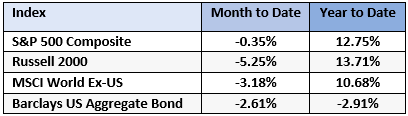
Inside the S&P 500 Index
Comedian George Carlin once quipped, “Think of how stupid the average person is, and realize half of them are stupider than that.” While from a statistical perspective, the median is the number in a data set in the exact middle, not the average, the point Carlin was trying to make is also true for the stock market. The return number you see above represents an adjusted average of all the stocks in the index. It’s calculated by adding up the returns of each stock multiplied by its weighting in the index. For the S&P 500, the weightings are based on the size of the company – bigger companies have bigger weights, with NVIDIA currently the largest at 8.3% of the index.
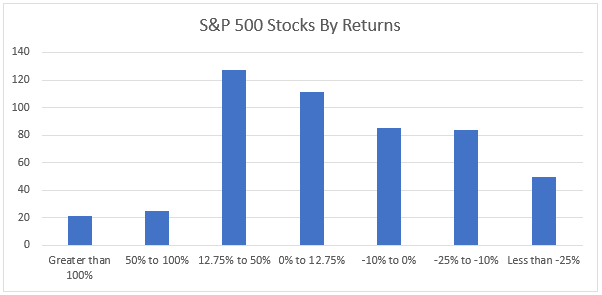
But if you look more closely, the actual returns of the stocks in the index vary drastically. The following chart gives more information on the stock level returns:
Source: Y Charts
Here are some interesting observations from this data:
- 21 stocks in the S&P 500 are up over 100% this year
- 173 stocks have outperformed the average (around 34.4% of the index)
- This means 65.6% of stocks have been worse than the average
- 219 stocks, roughly 43.5%, have lost money this year, even though the index is up double digits
With stocks performing so differently from each other, how should investors respond?
It depends on the purpose of the investment portfolio. Sometimes the purpose of the portfolio can be entertainment. In other cases, investors want to hold stocks that align with their employment or values. In such scenarios, it can make sense to concentrate or overweight specific investments.
For most of our clients, their purpose is funding retirement, education, or other important financial goals. In order for investments to satisfy these purposes, it’s necessary to achieve positive, reasonable returns, but it’s not necessary to achieve extremely high returns. On the other hand, if the portfolio achieves low or negative returns, the consequences can be dire. Most investors would rather plan for a high probability of reasonable success, rather than for a low probability of fantastic results. When the portfolio needs to continuously succeed, owning index-based investments is a wonderful way to diversify holdings, guarantee exposure to the best-performing stocks, and eliminate catastrophic outcomes over time. Picking specific stocks could lead to very high returns, but the probability of picking underperforming stocks is much higher.
Answering the question, “What is the money for?” can often give valuable insight into the appropriate investment strategy. We are happy to discuss this question with you anytime.
