
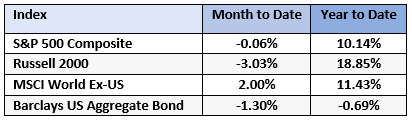
Markets had mixed results in July. International stocks increased, while all other asset classes declined. So far this year, all stock categories are up significantly, while bonds have languished.
Diversification 101
Diversification is one of the most commonly used words in investments. In fact, it might be the first and most foundational concept investors learn. How many times have you heard someone say, “Don’t put all your eggs in one basket!”? Even the book of Ecclesiastes (chapter 11, verse 2), written hundreds of years before the common era, says “But divide your investments among many places, for you do not know what risks might lie ahead.” Clearly, the concept of dividing your money into many different places has been around awhile. But diversification isn’t just about separating money into different buckets.
In order to properly diversify, investors must find two things: unlike investments and positive returns.
Finding Unlike (non-correlated) Investments – Correlation is a statistic that measures how closely two things relate to each other, on a scale from -1 to 1. A correlation of 1 means that they move in tandem, while a correlation of -1 indicates opposites. If the correlation is zero, they are unrelated.
- Positive Correlation: fuel prices and airline tickets – if fuel prices increase, ticket prices do the same.
- Negative Correlation: a vehicle’s age and its resale value – the older a car is, the less it is worth.
- Non-correlated: the number of siblings someone has and their favorite color – wholly unrelated things.
The following chart shows the correlations between different exchange-traded funds:
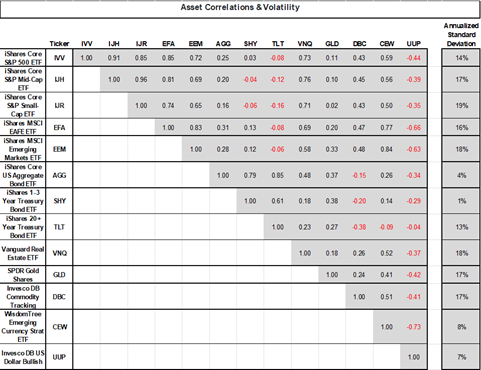
The top row shows how the S&P 500 (IVV) is correlated with other investments. For diversification purposes, we are looking for numbers relatively close to zero or negative. As you can see, mid-cap stocks (IJH), small-cap stocks (IJR), international stocks (EFA), and emerging markets (EEM) offer limited diversification benefit as all correlations are close to 1. Bonds (AGG, SHY, and TLT), commodities (GLD, DBC) and currency related investments (CEW, UUP) offer better diversification properties because their price movements are not as related to IVV. While all of these categories may belong in your portfolio, some are better diversifiers than others.
Finding Positive Returns – In his 1989 book One Up On Wall Street, legendary fund manager Peter Lynch invented the term “diworsification,” which meant adding mediocre or money-losing investments to a portfolio. When this happens, it reduces the long-run returns of your portfolio rather than reducing your risk. Because the stock market goes up over time, the risk of diworsification is real. Simply adding a higher number of investments isn’t the point. In order for an investment to truly diversify, it also has to make a sufficient return over time. Bonds have become better diversifiers as interest rates have increased (this helps bonds make more over time), while commodities have also performed better as inflation rates have been higher in recent years.
While the concept of diversification is as old as time, achieving it requires unrelated investments that make money over time. When implemented successfully, the result is manageable risk and attractive returns for investors.
If you would like to discuss specifically how we use diversification when managing your portfolio, please let us know.
